
The Supplement Labeling Lab | Week 2
When you look at a supplement bottle, which part of the label do you see first?
That sounds like a design question. But in dietary supplement labeling, it is also a regulatory one.
The principal display panel (PDP) is the part of the package most likely to be displayed, presented, shown, or examined under customary conditions of retail sale. In practical terms, it is generally the front of the package. Some packages may have more than one principal display panel, depending on their design. And that panel has specific requirements.
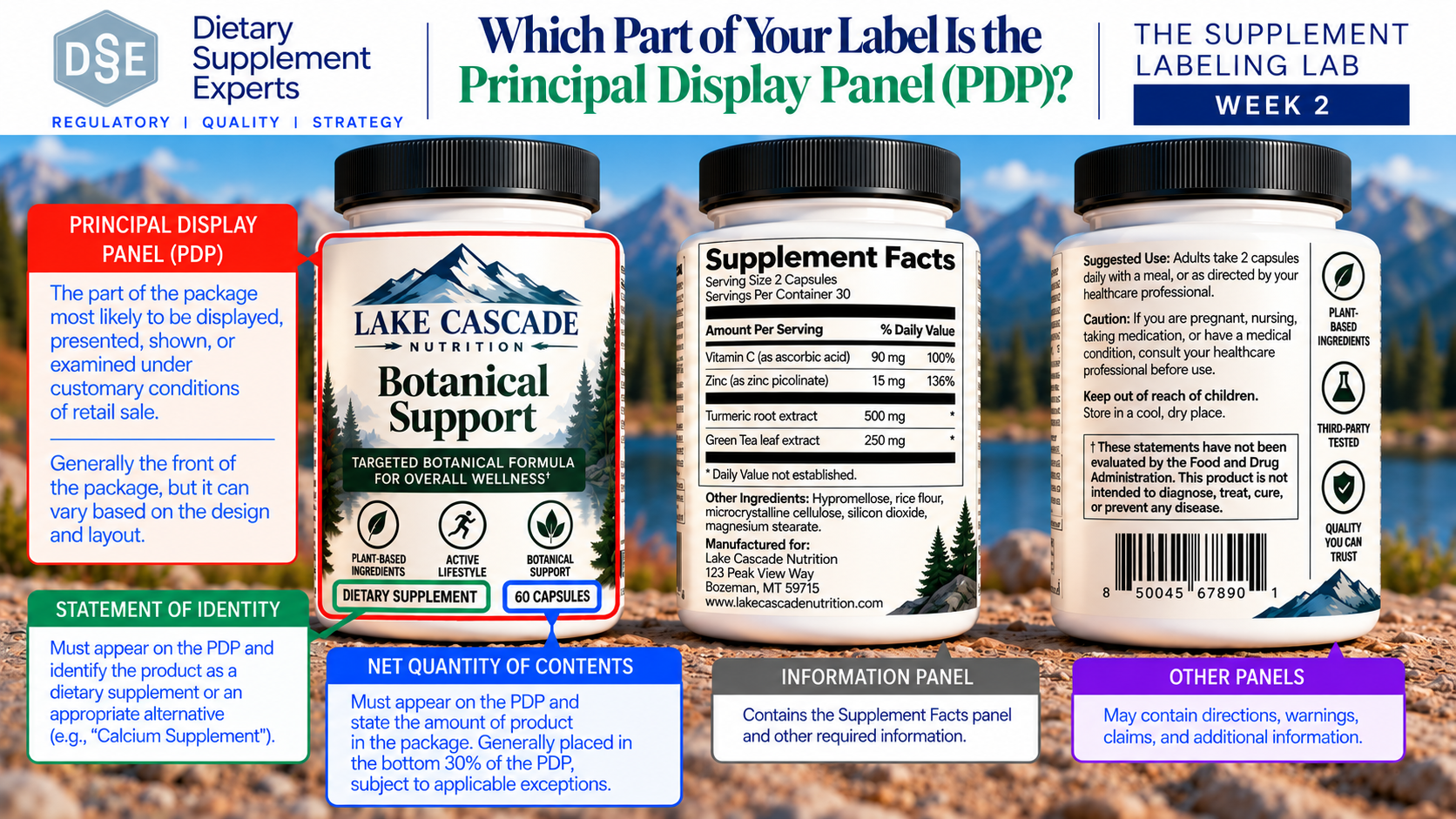
Two key components belong on the PDP
1. Statement of identity
The statement of identity tells consumers what the product is. For dietary supplements, this generally means identifying the product as a dietary supplement or using an appropriate alternative, such as “Calcium Supplement” or “Herbal Supplement,” when permitted.
A product name alone may not be enough. A creative name like “Lake Cascade Botanical Support” can help distinguish a product on the shelf, but it doesn’t necessarily tell consumers what the product is.
2. Net quantity of contents
The net quantity statement tells consumers how much product the package contains. Depending on the product, this may be expressed by weight, volume, numerical count, or an appropriate combination.
Its placement and presentation matter. The statement generally must appear as a distinct item in the bottom 30% of the PDP, subject to applicable exceptions. It must also be legible and presented in accordance with the applicable requirements.
A quick example
Imagine a Lake Cascade Nutrition bottle labeled “Botanical Support” in large, bold lettering.
The design looks great. The product name is prominent. But if the appropriate statement of identity is missing—or the net quantity statement is incorrectly placed—the front panel may still have a compliance problem.
The lesson? Don’t confuse prominent branding with required labeling information.
The takeaway
When reviewing a supplement label, start by identifying the PDP. Then check the statement of identity and net quantity of contents before moving on to the other panels.
A strong design attracts attention. A systematic label review helps ensure the required information is there, too.
Next week: We’ll look more closely at the statement of identity—and why the name consumers remember isn’t always the name the label needs.
Need help reviewing your dietary supplement label? Dietary Supplement Experts (DSE) helps businesses identify labeling issues and assess compliance before artwork approval and product launch.
Sources & Further Reading
- FDA, Dietary Supplement Labeling Guide — Chapter I: General Dietary Supplement Labeling
- FDA, Dietary Supplement Labeling Guide — Chapter II: Identity Statement
- FDA, Dietary Supplement Labeling Guide — Chapter III: Net Quantity of Contents
- Regulations: 21 CFR § 101.1 — Principal display panel, 21 CFR § 101.3 — Identity labeling, and 21 CFR § 101.105 — Declaration of net quantity of contents.