
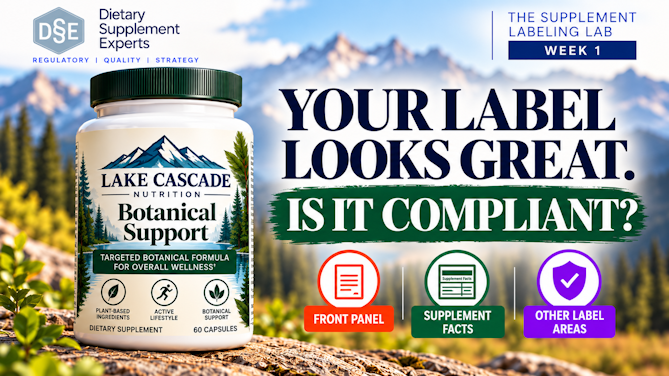
The Supplement Labeling Lab | Week 1
A dietary supplement label does more than tell consumers what’s inside the bottle. It identifies the product, communicates important information, provides required declarations, and helps consumers understand how to use the product. Each of those jobs comes with rules.
A label can look polished, professional, and ready for the printer while still having compliance problems. That’s why reviewing dietary supplement labels requires more than checking spelling or making sure the Supplement Facts panel looks right.
A good label review starts with understanding what the label is required to do.
Start with the panels
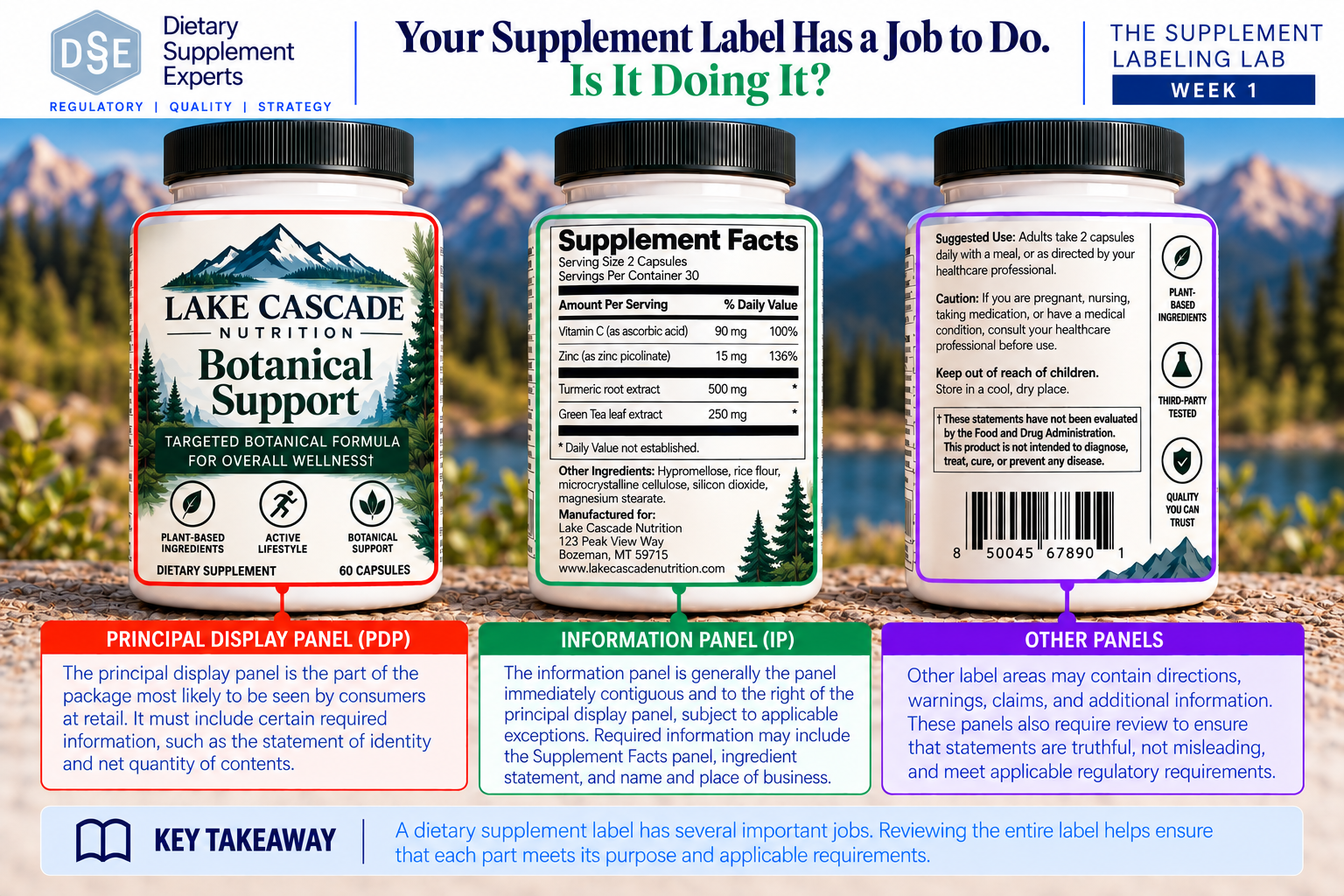
Dietary supplement labels have different areas, each with its own requirements.
The Principal Display Panel (PDP) is generally the part of the package most likely to be seen by consumers at retail. Among other requirements, it must display the statement of identity and net quantity of contents.
The Information Panel (IP) is generally the panel immediately contiguous and to the right of the PDP, subject to applicable exceptions. Required information may include Supplement Facts, the ingredient statement, and the name and place of business of the manufacturer, packer, or distributor.
Other label areas may contain directions, warnings, claims, and additional information. These areas deserve careful review, too. Claims and other statements can create compliance concerns even when the required label components appear to be in order.
Knowing where these areas begin and end is a useful first step. But identifying the panels is only the beginning. The content, wording, placement, and presentation of required information matter, too.
A simple example
Imagine a Lake Cascade Nutrition supplement bottle with attractive front-label artwork, a clean Supplement Facts panel, and a professionally formatted ingredient list.
Everything looks good.
But has anyone verified that the statement of identity meets applicable requirements? Is the net quantity statement presented correctly? Are the ingredients declared appropriately? Have the required label statements been included and placed correctly? Does the product require a warning that hasn’t made it onto the label?
A designer can produce beautiful artwork without necessarily knowing the regulatory requirements. And a label that resembles a competitor’s label isn’t automatically compliant, either.
That’s why a systematic label review matters.
The takeaway
Before approving supplement label artwork, look beyond the design. Identify the required label components, understand the rules that apply to each, and review the complete label in context.
Over the coming weeks, DSE will break dietary supplement labeling into practical lessons, using examples, regulatory references, and real-world mistakes to explain what reviewers should look for and why it matters.
Your supplement label has a job to do. Make sure it does it correctly.
Need help reviewing your dietary supplement label? Dietary Supplement Experts (DSE) helps businesses identify labeling issues and assess compliance before artwork approval and product launch.
Sources & Further Reading
- FDA, Dietary Supplement Labeling Guide — Chapter I: General Dietary Supplement Labeling
- FDA, Dietary Supplement Labeling Guide — Chapter II: Identity Statement
- FDA, Dietary Supplement Labeling Guide — Chapter IV: Nutrition Labeling
- Regulations: 21 CFR §§ 101.1, 101.2, 101.3, 101.5, 101.36, and 101.105.